
 Download
Developed by mathematician John Conway in 1970, Conway's Game of Life presents a fascinating mathematical simulation.
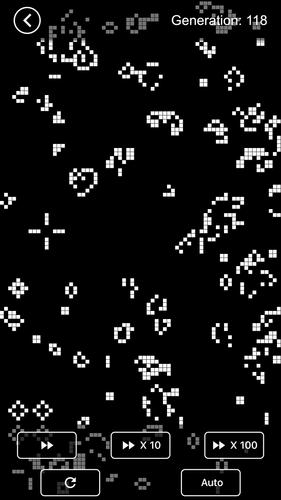
This cellular automaton unfolds across an infinite 2D grid where cells exist in either alive or dead states. During each generation (game turn), every cell's status updates based on its eight immediate neighbors - those touching horizontally, vertically, or diagonally.
Starting with an initial pattern as Generation 1, subsequent generations emerge through simultaneous application of rules across all cells. The evolution continues as these rules iteratively shape future states. A cell's fate depends on these fundamental principles:
A live cell survives with exactly 2 or 3 living neighbors
A dead cell revives only when surrounded by precisely 3 live neighbors
Numerous rule variations exist, each featuring different survival and birth conditions. After extensive experimentation, Conway established these specific rules that balance expansion and extinction thresholds remarkably. This delicate equilibrium produces exceptionally intricate patterns - demonstrating how simple rules can generate profound complexity at chaos boundaries.